
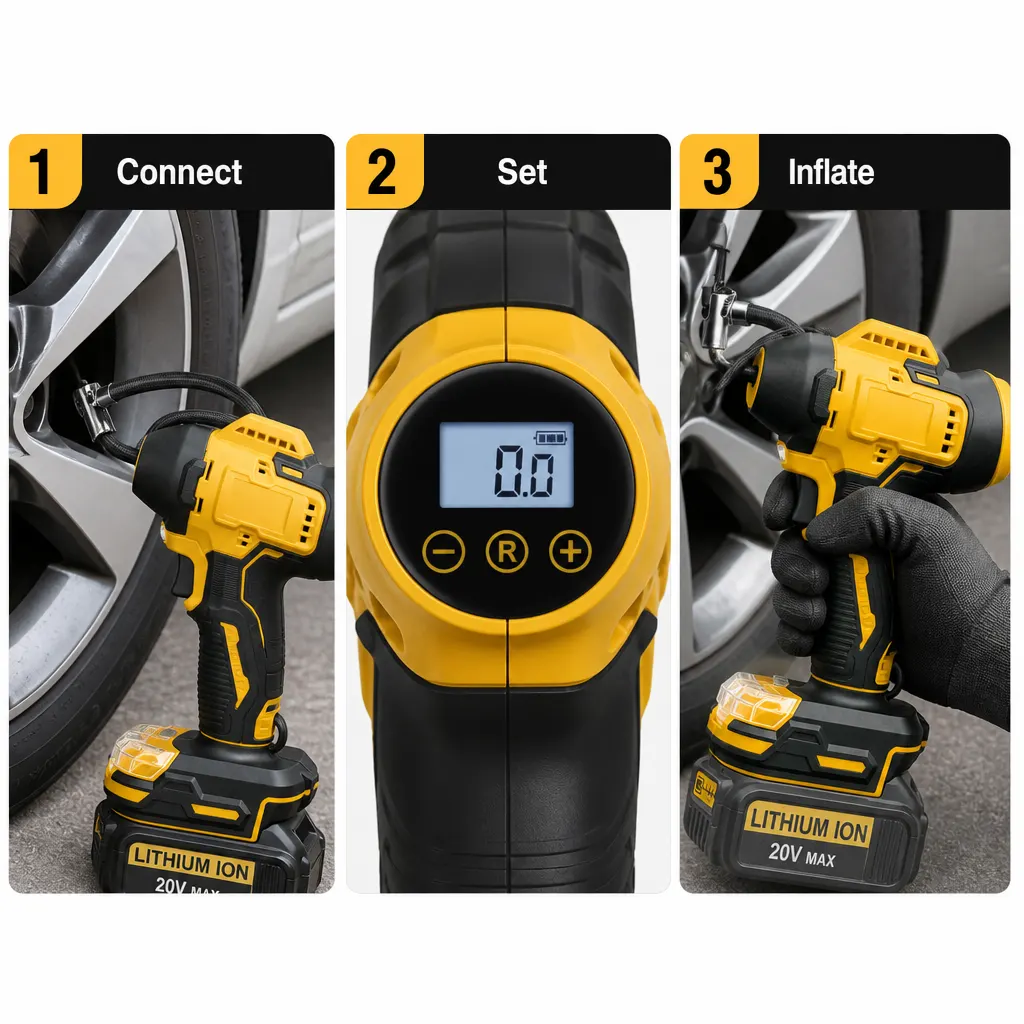
Short answer: An 18V cordless tyre pump is only a good match when the battery interface, vehicle pressure requirement and intended inflation job line up. The Tyrepump product page describes a dual-cylinder cordless inflator with a digital display, lighting and tyre-pressure gauge functions, using a DeWalt-style battery interface. It does not state a battery voltage list, charger supply, pressure accuracy, maximum pressure, airflow, runtime or inflation time. UK buyers should read the vehicle handbook or tyre-maker guidance for the required pressure, confirm the battery fit and treat every unlisted performance figure as unknown before ordering or relying on the pump.
Check what 18V means for this product
The product title and description use a DeWalt-style battery interface, while the search phrase uses 18V. Those are not interchangeable facts. The current page does not publish a full voltage, battery-family or charger compatibility list, so a buyer should not assume that every 18V pack will slide on, lock correctly or deliver the intended operating result.
The useful first check is the battery already owned and the exact interface shown by the seller. If the pump needs a battery or charger that is not included, factor that into the purchase. The manufacturer does not specify the battery supply, runtime or protection behaviour on the public page.
| Buying question | Current page | Confirm before ordering |
|---|---|---|
| Pump format | Dual-cylinder cordless inflator | The intended use and duty pattern |
| Battery connection | DeWalt-style interface | Exact battery family and fit |
| Controls | Digital display, lighting and tyre-pressure gauge functions | Display and gauge accuracy |
| Performance | Not stated in full | Maximum pressure, airflow, runtime and inflation time |
Use the vehicle handbook as the pressure reference
A pump should be used to reach the pressure specified for the vehicle and load, not a number chosen from the pump's product title. GOV.UK says the vehicle handbook tells you how often to check tyres and that tyres must have the correct tread depth and be free of cuts and defects. The vehicle handbook remains the right place to confirm the required pressure for the specific vehicle.
The product page says that a digital display and tyre-pressure gauge functions are present. It does not publish pressure accuracy or calibration. Read the displayed value as an instrument indication and verify the tyre, valve, temperature and vehicle requirements using the handbook or a suitable independent check.
- Find the vehicle's specified cold tyre pressure in the handbook or the manufacturer's stated location.
- Inspect the tyre and valve for visible damage before inflating.
- Confirm the battery interface and fit the correct battery according to the product instructions.
- Inflate to the vehicle's stated requirement while monitoring the displayed pressure.
- Recheck the tyre and stop if the reading, valve or tyre condition is abnormal.
Separate useful features from unlisted performance
Dual cylinders may sound attractive for a portable pump, and the page also lists lighting and a digital display. Those are the documented feature points. They do not establish how quickly a particular car, van, bicycle or inflatables item will inflate, how long the pump can run, or whether the gauge agrees with another instrument.
The manufacturer does not specify maximum pressure, airflow, duty cycle, runtime, battery capacity, charging arrangement or noise on the current page. Do not turn the format into a performance promise or use an unknown figure to plan a roadside recovery.
Limits and checks before buying
The inflator may fit a buyer who already has the exact compatible battery interface and needs a portable top-up tool for pressure checks guided by the vehicle handbook. It is not a guarantee of roadworthiness, pressure accuracy, compatibility, inflation speed or emergency reliability.
Confirm the battery, charger, pressure range and intended duty with the seller or manual. If the vehicle depends on a precise pressure result or the job requires repeated heavy-duty inflation, choose a product with explicit supporting specifications.
Related guides and product details
For an 18V cordless tyre pump, verify the battery interface and vehicle pressure first, then buy only within the performance limits the documentation actually states. Read Cordless Tyre Inflator UK: A Careful Buying Guide for related guidance. Read DeWalt Battery Tyre Inflator: Check Compatibility First for related guidance. Review the documented specification on the Dual-Cylinder cordless tyre inflator for DeWalt-style battery interface product page before ordering.
Sources and safety context
- Supports the dual-cylinder format, DeWalt-style interface, digital display, lighting and tyre-pressure gauge functions. Current Tyrepump dual-cylinder inflator product page.
- Supports using the vehicle handbook for tyre checks and checking tread, cuts and defects. Check your vehicle is safe to drive.
- Supports using the vehicle or tyre manufacturer's pressure guidance and checking pressure carefully. Tyre pressure advice.