Choose the cordless tyre inflator UK option around the job

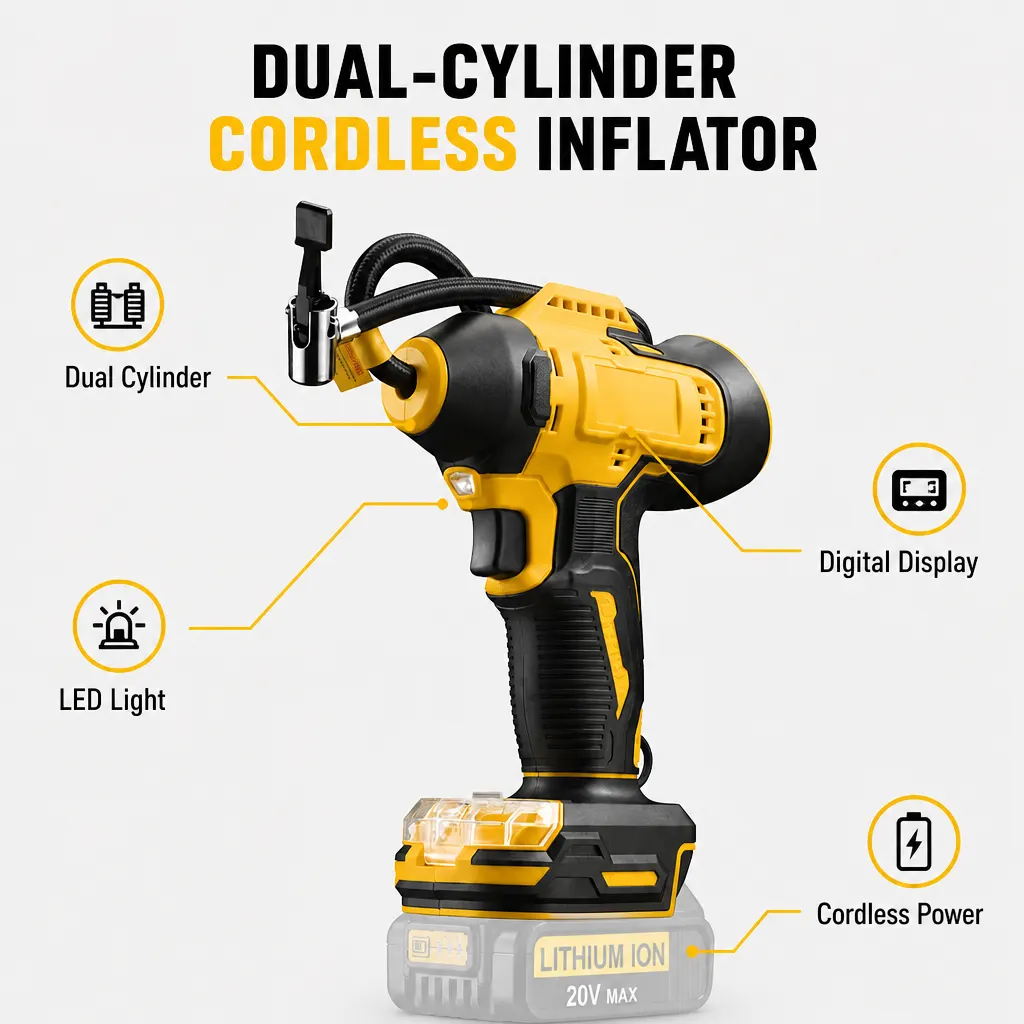
Dual-Cylinder Cordless Tyre Inflator For DeWalt-Style Battery Interface controls and screen

For a driveway top-up or a pressure check at a UK packing yard, workshop or campsite, start by matching the inflator to the tyre task and the battery interface you can genuinely use. The documented configuration here is a dual-cylinder cordless tyre inflator with a DeWalt-style battery interface, digital display, lighting and tyre-pressure gauge functions. That makes it worth considering if you already work with the named style of battery interface and want to avoid a 12V cable. Before buying, confirm the precise battery fit and what arrives in the selected configuration rather than assuming a battery is included.

The buying decision is not simply about finding the fastest-looking pump. A car owner may need occasional pressure correction on a driveway, while a van or motorhome owner may need to work around larger tyres in a yard or at a campsite. Those settings create different demands around access, visibility, storage and the time available beside the vehicle. A dual-cylinder format may be attractive for regular top-ups, but the available product facts do not state an inflation time, maximum pressure, battery capacity, runtime or guaranteed performance on a particular tyre size. Those unknowns should shape your questions before purchase.

Set the UK driveway or workshop scene before comparing pumps

Picture a cold morning outside a semi-detached house in Leeds, with one tyre looking lower than the others before a school run or motorway trip. A cordless unit can be easier to position than a pump that depends on a 12V socket and a cable reaching from the cabin. The lighting function is also relevant when a pressure check happens in a dim driveway or garage. However, cordless convenience only helps if the battery interface is already available, charged and suitable for the selected configuration. If you do not have that battery arrangement, the apparent simplicity may disappear.

The same question looks different at a van depot in Bristol or beside a motorhome on a North Wales pitch. Larger vehicles can make hose access, repeated inflation and storage more important than a compact footprint alone. The documented facts identify a dual-cylinder design, a digital display, lighting and gauge functions, but they do not confirm a particular van, motorhome or caravan tyre range. Treat the product as a candidate for investigation, not as a guaranteed answer for every high-pressure tyre. Check the tyre maker’s stated pressure and ask whether the inflator is intended to reach it.

Check the battery interface and what is actually supplied

The most important compatibility check is the phrase “DeWalt-style battery interface”. That wording identifies the interface described for the selected configuration; it does not, by itself, establish official DeWalt branding, certification or compatibility with every battery sold under that family of shapes. Compare the interface shown for the exact offer with the battery you own, including its physical fit and any stated requirements. Do not rely only on a familiar colour, brand reference or a photograph from a different listing. A tool that cannot accept your battery is not cordless convenience for your bench or vehicle.

Also check the contents of the exact configuration before planning a tyre check. The supplied product facts describe the inflator and its functions but do not list a battery, charger, hose, valve connector or other accessories in the kit contents. That means you should not assume that a battery or adapter is provided. If the purchase is a bare unit, you will need to plan how the compatible battery is charged and where the accessories are kept. For a tradesperson moving between a workshop and a van, this small check can prevent a frustrating discovery beside a soft tyre.

Match the display, gauge and lighting to the pressure-check routine

A digital display and tyre-pressure gauge function can make the checking process easier to follow because the pressure reading is visible on the unit rather than hidden in a separate gauge. In a garage, the lighting function may help you see the valve area when the vehicle is parked after work. These are documented functions, not proof of a particular level of accuracy. Use the vehicle manufacturer’s recommended cold-tyre pressure as the target and compare readings carefully if you already use a trusted gauge. The inflator should support your checking routine, not replace sensible verification.

Do not turn the presence of a display into assumptions about features that are not documented. The available product facts do not confirm measurement units, preset pressure programming, automatic shut-off, a stated accuracy tolerance or a specific pressure range. Those details matter if you want to set a target and leave the machine running without close supervision. Ask for them or look for them in the exact product information before relying on that workflow. Until confirmed, plan to remain with the pump, watch the reading and stop according to the manufacturer’s instructions.

Spot the mismatches before taking it to a roadside job

This type of cordless inflator may be a sensible shortlist item for topping up tyres when the battery interface and working location suit it. It may be less suitable if you need a proven inflation time from nearly flat, a confirmed maximum pressure, continuous operation guidance or performance data for a particular motorhome tyre. None of those figures is present in the documented product facts. A dual-cylinder label tells you the listed format, but it does not quantify airflow, heat management or the number of tyres one battery can handle. Avoid buying on the cylinder count alone.

There is also a practical distinction between correcting pressure and dealing with a tyre problem. A slow puncture that repeatedly loses air should be investigated rather than treated as a permanent pumping job. If a tyre is visibly damaged, has come off the bead or is unsafe to drive on, an inflator is not a substitute for proper assistance. Likewise, someone who needs workshop compressor duty, a confirmed high-pressure capability or long sustained runs should wait for written specifications that address those needs. The right buyer is one whose task fits the documented functions and whose unanswered questions are resolved.

Use this driveway-to-van comparison checklist

Start with the surface and setting: will you use the unit on a home driveway, inside a garage, at a warehouse loading area or beside a campsite? Then check the tyre task: a routine top-up, a pressure check after a cold snap, or inflation of a larger vehicle tyre. Next, compare the product facts: dual-cylinder format, DeWalt-style battery interface, digital display, lighting and gauge functions. Finally, identify the missing information that could change your decision, including the exact pressure range, inflation time, battery runtime, operating guidance and included accessories.

Work through the checklist in this order: identify the vehicle’s recommended pressure; inspect the tyre and valve; confirm the battery physically fits the selected configuration; check whether the kit includes the connector and battery you need; position the inflator where the display and lighting are usable; monitor the gauge while inflating; and recheck the pressure afterwards. If any step depends on an unconfirmed feature, mark it as a question rather than filling the gap with an assumption. This sequence keeps the decision tied to the actual driveway, workshop or roadside job.

Decide whether cordless is better than your existing 12V pump

If you already own a working 12V inflator, compare the complete workflow rather than just the headline design. A corded pump may already cover your car and live in the boot, while a cordless option could remove the need to reach a vehicle socket. On the other hand, the cordless unit depends on the specified battery interface and a charged battery. For a home DIYer who already keeps compatible batteries in a workshop, that may be a useful consolidation. For someone without them, the change may add another compatibility and charging decision.

The dual-cylinder cordless format is the central point to investigate, especially if your job involves repeated tyre top-ups or a van at a UK depot. But the public facts supplied here do not provide a measured comparison with a 12V pump, an OEM unit or another cordless model. Do not present it as faster, quieter, more accurate or more durable without evidence. Compare the things you can verify: interface, display, lighting, gauge function, physical size if documented, contents and stated operating limits. That produces a fairer choice than relying on a general claim about cordless performance.

Take the next step with the exact configuration in front of you

Before ordering, open the precise offer for the dual-cylinder cordless tyre inflator and write down five answers: which battery interface is shown, whether a battery is included, which valve connection is supplied, what pressure range and operating limits are stated, and whether the display and gauge information matches your preferred units. Then compare those answers with the vehicle handbook, tyre placard and your intended setting. If you are preparing a van or motorhome for a long journey, pay particular attention to any guidance about sustained operation and the pressure required by that vehicle.

If the answers fit your job, keep the inflator, compatible battery and any required accessories together in the vehicle or workshop location where a pressure warning is most likely to be handled. Make a habit of checking pressures when the tyres are cold and stop to investigate repeated pressure loss. If the listing cannot answer a safety-critical compatibility or pressure question, pause rather than guessing. A cordless tyre inflator UK buyer can make a confident choice without exaggerated promises: match the named interface, use the documented display, lighting and gauge functions, and only expect performance that the product information supports.