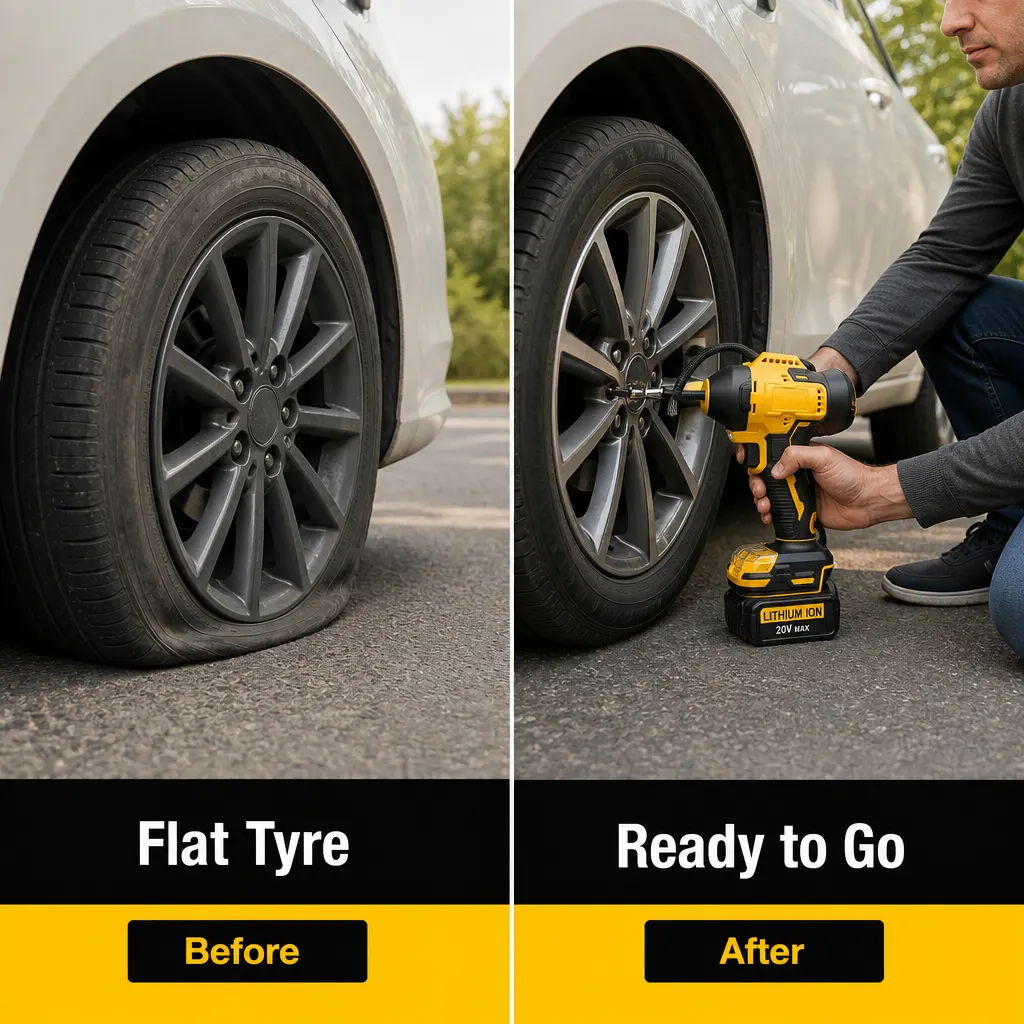
Choose the DeWalt battery tyre inflator by the battery interface first

If you are looking at a DeWalt battery tyre inflator, first confirm that the battery interface matches the packs you intend to use and that the purchase includes what you need to operate it. The documented product is a dual-cylinder cordless tyre inflator using a DeWalt-style battery interface in the selected configuration. It also lists a digital display, lighting and tyre-pressure gauge functions. Those facts make it worth considering for a driveway, garage or workshop top-up, but they do not confirm every battery fit, included accessory or pressure range.
The right buying decision therefore depends on the job rather than the brand name alone. A car owner may want a cordless unit available beside the packing bench or in the boot, while a van or motorhome owner may need documented evidence about higher-pressure tyres and longer inflation sessions. Before paying, match the product listing against your own battery, valve arrangement, tyre pressures and storage plan. Treat “DeWalt-style” as interface wording, not as proof of official DeWalt manufacture, approval or universal compatibility.
Set the job at a UK driveway, garage or workshop bench
For a UK car owner, the practical setting is often a driveway or domestic garage: you notice a soft-looking tyre, read the vehicle’s recommended pressure, and want to correct it without moving the car to a forecourt. A cordless format can be convenient in that setting because the product is described as battery-operated rather than as a 12V plug-in pump. The documented lighting function may also be relevant when the check happens beside a garage after work or during a darker winter afternoon, although no brightness or runtime is specified.
A tradesperson working beside a van or a small workshop may be considering the same format for a different reason. The dual-cylinder description may sound attractive when a larger tyre needs attention, but the supplied facts do not state inflation speed, maximum pressure, duty cycle, motor temperature limits or the number of tyres a battery can handle. If the job involves repeated inflation at a worksite, do not infer performance from the cylinder count alone. Use the listing as a starting point and seek the missing operating information before relying on it for a planned journey.
Check the documented product facts against your tyre routine
The useful facts currently documented are specific but limited: this is a dual-cylinder cordless tyre-inflator format; the selected configuration uses a DeWalt-style battery interface; and the listed functions include a digital display, lighting and a tyre-pressure gauge. These points support a comparison with a corded pump or a separate rechargeable unit. They do not establish whether a battery is supplied, which adapters are in the box, whether the display shows PSI, bar or another unit, or whether the pump has an automatic stop.
Before choosing it for a car, van, campervan or workshop vehicle, compare the listing with the information printed on your tyre placard or vehicle handbook. Check the required pressure, valve access, hose or connector arrangement and where the pump will be stored. Then check the offer page for battery and charger status, included contents and operating instructions. Because the frozen product information contains no measurements, weight, hose length, pressure range or runtime, those details should remain open questions rather than assumptions in your buying decision.
Use this driveway buying checklist before ordering
Use the following sequence at the packing bench or before placing the order. First, identify the battery: compare the exact DeWalt-style interface shown in the offer with the battery pack you own, without assuming that every pack with a similar appearance will fit. Second, identify the surface and setting: a level driveway, garage floor or workshop bench gives you somewhere stable to position the inflator while you read the display. Third, identify the content: confirm whether the offer is for the inflator alone or includes a battery, charger, hose and valve accessories.
Next, check the tyre task rather than relying on the phrase “dual-cylinder”. Write down the pressure required by your vehicle, the number of tyres you normally check, and whether the job is an occasional top-up or a larger-vehicle inflation task. Then confirm the documented functions you actually need: digital display, lighting and pressure-gauge use are listed, while maximum pressure, automatic shut-off, inflation time and battery endurance are not. Finally, plan aftercare by checking how the interface, hose and display are to be kept clean and stored, because no specific maintenance instructions are supplied in the frozen facts.
Identify mismatches before using it on a van or motorhome
The main mismatch risk is buying for a demanding vehicle without evidence that the unit suits it. A van, campervan or motorhome can present a different job from a small car, particularly where tyre pressures, tyre volume and the number of wheels make the session longer. The documented facts do not provide a maximum pressure, an intended vehicle class, a continuous operating period or a cooling requirement. They also do not say how many inflation sessions a particular battery can support. That missing information matters more than the dual-cylinder label if the pump is intended for touring or roadside dependence.
There is also a compatibility mismatch to avoid. The listing describes a DeWalt-style battery interface, but the supplied public facts do not state official DeWalt branding, certification or compatibility with a named battery series. Do not buy on the assumption that a pack will lock in safely because it resembles another tool battery. If you cannot verify the interface and the included contents from the product page, pause and ask for clarification. A separate inflator with a clearly documented battery system may be the more suitable choice when certainty is more important than cordless convenience.
Know who should pause before buying this cordless inflator
This product is not an obvious choice for someone who needs a fully specified workshop compressor. The frozen facts do not document an air-tool outlet, tank, pressure regulator, hose length, duty cycle or continuous-use rating. They also do not establish a particular inflation time or performance at high pressures. If your workshop routine involves repeated work on several large tyres, powering air tools or following a fixed service procedure, compare those requirements with the listing and do not fill the gaps with marketing inference.
It may also be the wrong purchase if you do not already have a confirmed matching battery or if you need a complete ready-to-use kit. The public information does not list the kit contents, so the battery, charger, adapters and storage arrangements must be checked rather than presumed. Likewise, a digital display and gauge function do not automatically prove measurement accuracy against your preferred reference gauge. For a pressure warning, slow leak or visibly soft tyre, investigate the underlying tyre or valve problem as well; an inflator can add air, but the documented product facts do not claim to diagnose or repair a fault.
Compare the cordless format with the actual alternatives on your bench
A 12V inflator may remain sensible if your car has a suitable power socket and you prefer not to manage a tool battery. Its advantages and limitations depend on the particular model, so compare the documented cable length, power requirements, pressure range and controls rather than assuming that cordless is automatically faster. A separate rechargeable pump may suit someone who does not own compatible tool batteries, while a mains compressor may better match a fixed workshop. The DeWalt-style option is most relevant when the interface is confirmed and the cordless arrangement solves a real access problem.
Make the comparison concrete. For each candidate, write down the power source, battery or cable requirements, stated pressure range, display or gauge type, lighting, included valve equipment, physical dimensions and storage method. Then add the information that is missing from this listing: battery inclusion, compatible pack details, automatic shut-off, maximum operating pressure and any stated cooldown guidance. The documented DeWalt-style model can be compared fairly only when those blanks are answered. Avoid choosing because one specification sounds stronger in isolation; the useful question is whether the complete setup fits the job at your driveway, garage or workshop.
Take a documented next step before putting it in the boot
Before ordering, open the exact saved configuration and verify four points in writing: the battery interface, the contents of the package, the pressure units and range, and the operating guidance for your intended tyre type. Confirm that the product description still states a dual-cylinder cordless tyre inflator and lists the digital display, lighting and gauge functions. If the page adds measurements or instructions, use those current details rather than relying on a search snippet. If it does not answer your questions, contact the seller before purchase and keep the response with your buying notes.
Once the facts match your setting, plan a calm first use on the driveway or workshop floor rather than waiting for a roadside problem. Read the vehicle’s recommended pressure, connect the valve carefully, observe the displayed reading and check the tyre again with your normal reference method if you have one. Store the inflator with the confirmed compatible battery arrangement and any supplied accessories, and inspect the tyre if pressure falls again. That process lets you judge the purchase on fit, content and documented function instead of on unsupported promises about speed, range or official battery compatibility.